Most investors assume that selecting the four teams for the Coeus portfolio is the end of the story. It is not. The weight each team receives matters too. And those weights are not static. They are determined dynamically.
At the end of every month, Investment Management reviews how the four strategies should be positioned for the month ahead. We mainly look at three things.
- First, market regime. Are currencies beginning to trend more persistently, or does market behaviour appear to be becoming more mean-reverting? That assessment can influence which teams receive somewhat more weight.
- Second, event risk. Some months contain potentially disruptive events: major central-bank decisions, Jackson Hole, policy reviews or exceptional budget announcements. Strategies that can build large directional exposures may then deserve a little less room.
- Third, portfolio interaction. A team may look attractive in isolation, but if several teams are expressing similar exposures, increasing them all can quietly turn diversification into concentration. We therefore also consider what an allocation does to the portfolio as a whole.
That all sounds sensible. But sensible is not the same as valuable.
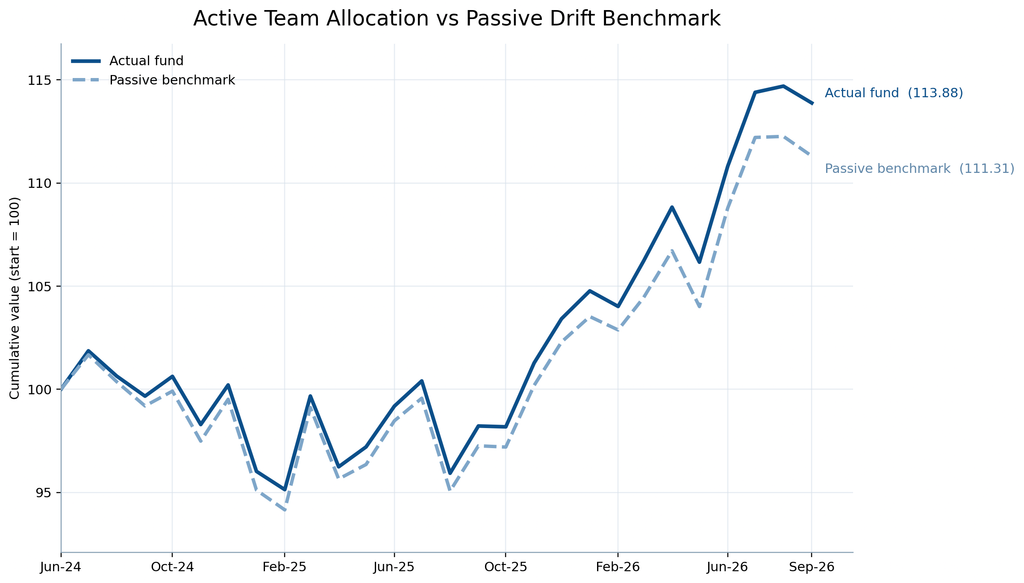
So we tested it. For this purpose, we use the gross returns of the teams and the gross return of the fund. We created a benchmark by starting a hypothetical portfolio in June 2024, with 25% allocated to each team. June 2024 was chosen because that was the month in which the fourth team, Balanced, was added to the portfolio.
From then on, we did not assume any active allocation decisions. Each team’s weight was simply allowed to drift with performance. A strongly performing team therefore became slightly larger; a less strongly performing team slightly smaller.
We then compared that passive portfolio with the actual fund.
By August 2026, the passive portfolio had grown from 100 to 111.31. The actual fund reached 113.88. A difference of 2.57 percentage points.
And not at the cost of higher volatility. Monthly standard deviation was approximately 2.52% for the passive portfolio, versus 2.46% for the actual fund.
Not every monthly allocation decision will be right. But the result does challenge a convenient assumption: that once you have selected several good strategies, the job is done.
It is not only which strategies you own. It is also how you combine them. For a fund where every percentage point counts, active allocation is not an administrative detail. It is part of the investment process.