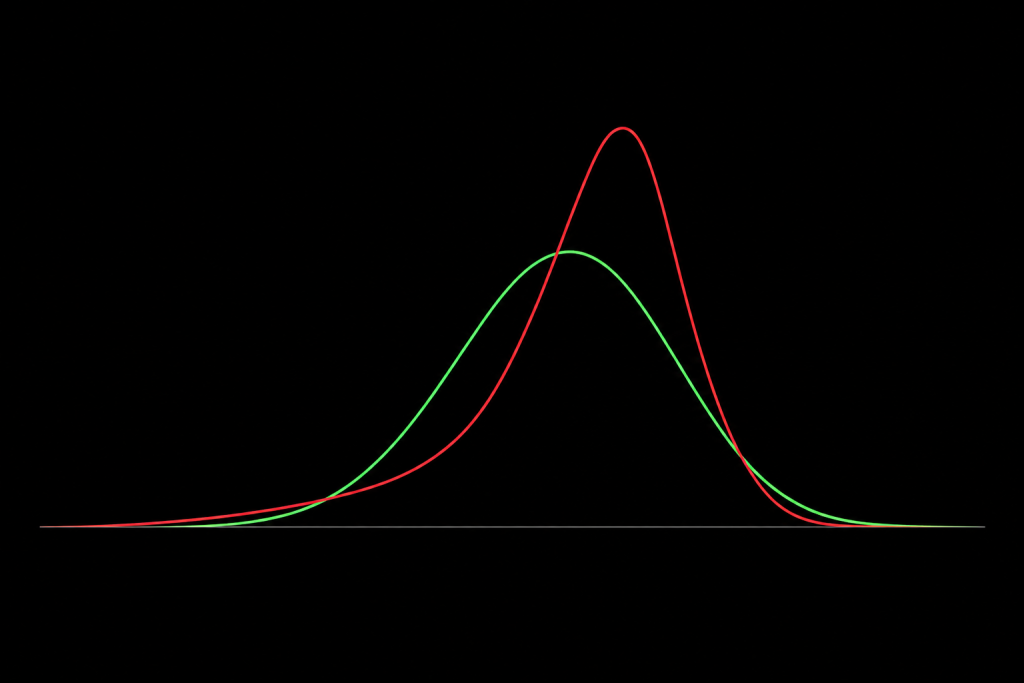
The four strategies in our fund together have historically produced a Sharpe ratio of 1.48. The Sharpe ratio measures the amount of return earned above the risk-free rate for each unit of volatility taken. To put that 1.48 into perspective, over the same period the MSCI World Index produced a Sharpe ratio of approximately 0.64, while the Vanguard Global Bond Index Fund came in at -0.27.
So 1.48 is a number we are quite pleased with. But Sharpe only tells part of the story. Looking deeper into our monthly return distribution, we find a skewness of -0.85 and a kurtosis of 5.24.
Skewness measures the asymmetry of returns. A negative number means that the downside tail has been more pronounced than the upside tail. That matters because investors do not experience gains and losses symmetrically. A loss of three units generally hurts more than a gain of three units pleases. This explains loss aversion. And the mathematics is even less forgiving. A 10% loss requires an 11.1% gain to recover. A 30% loss requires a 42.9% gain. Large losses relative to normal therefore hurt twice: emotionally, and mathematically.
Kurtosis tells us something different: how much of the distribution sits in the tails. A normal distribution has a kurtosis of 3. A higher number means that extreme observations occur more often than a normal distribution would suggest.
Neither figure is particularly alarming. Financial markets rarely behave like perfect normal distributions. Equity markets, too, tend to exhibit negative skew and kurtosis above 3. Trust takes years to build, seconds to break. Gains tend to accumulate gradually, while losses can arrive abruptly and in much larger increments.
So far, nothing unusual.
But there was another feature of our portfolio that bothered us more. Historically, a substantial part of the fund remained in cash. That cash was not required for margin, even under the stress scenarios used in our risk management. Now, cash may be safe but idle cash is not necessarily efficient.
At the beginning of 2026, we therefore changed the structure of the portfolio. We concentrated our four existing trading strategies into 50% of the portfolio, allowing them to operate with twice their previous risk allocation. The remaining capital was allocated to third-party alternative strategies, predominantly arbitrage-driven. The objective was straightforward: put excess cash to work and improve return potential without simply adding more exposure to the same sources of risk.
Arbitrage strategies are not dependent on whether currencies, equities or bonds rise or fall. They carry their own risks — including counterparty, liquidity and execution risk — but they tend to make and lose money for different reasons than our trading strategies do.
Does that suddenly make Coeus a hybrid between a fund-of-funds and a trading fund? No. We remain a trading fund. We simply decided that excess cash should work as well.
But something else has happened since the change. Because the two groups of strategies respond differently to market conditions, an extreme observation in one part of the portfolio can be partly offset by a more stable result elsewhere. In other words, diversification may affect more than volatility. It may also affect the shape of the return distribution. And that is exactly what the first nine months of 2026 suggest. Skewness over that period was approximately -0.05, effectively neutral, while kurtosis fell to 2.59, slightly below the 3 associated with a normal distribution.
Those numbers are striking. However, they are also far too early to celebrate. One swallow does not make a summer. And nine months do not make a track record. But so far, the combined portfolio has produced a more symmetric return distribution, where extreme monthly observations play no role.
We changed the portfolio to make excess cash productive. If that same decision also produces a better-shaped return distribution, we will happily take that as a bonus.