Ever heard of the term “competitive shopping”? Probably not. Neither had we.
The Los Angeles Police Department used it after a rather memorable Black Friday at a Walmart in Porter Ranch in 2011. Shortly after the sale began at 10 p.m., shoppers rushed towards heavily discounted video games and electronics. One woman apparently decided that elbows alone did not give her enough of an edge. In view of the moving crowd, the competitive advantage of the store was clear. The woman’s competitive advantage? Pepper spray. She used it unsparingly on the crowd around her. With maximum commitment and with very little regard for subtlety. The tactic worked: she reached the merchandise, completed her purchase and left before police could identify her. Around twenty shoppers were affected.
Police later described the incident as “competitive shopping”. A year later, the LAPD deployed extra officers around shopping centres. One commander even felt compelled to remind the public that shopping may be competitive, but once pepper spray enters the equation, shopping definitely crossed the line into a contact sport.
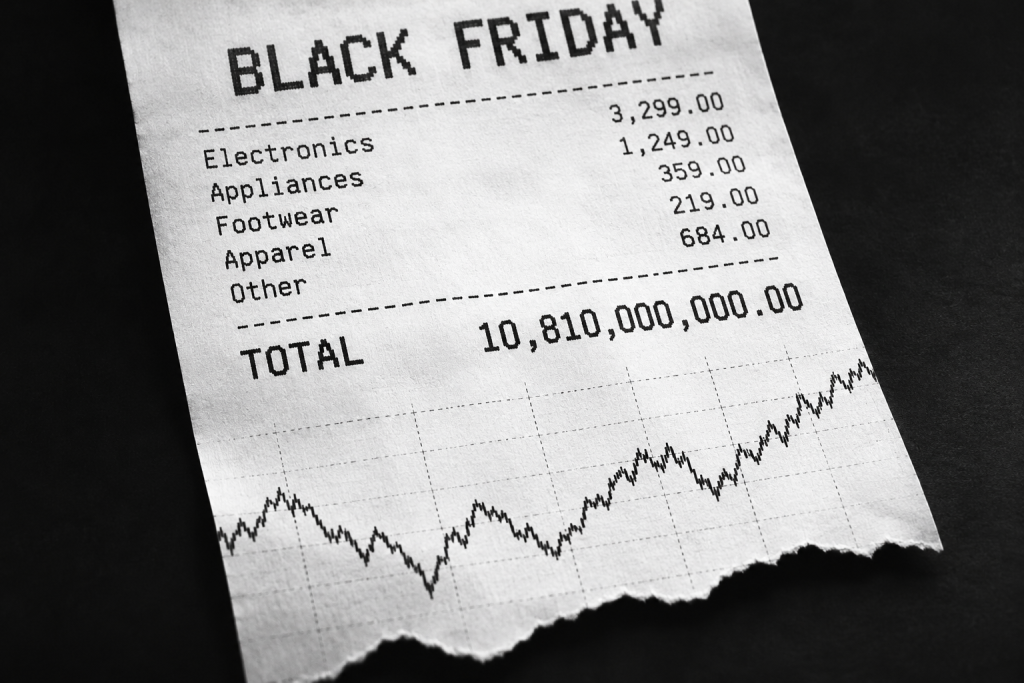
Black Friday does not always bring out the best in people. But what does it do to investors? In economic terms, the scale is hard to ignore. In 2024, Americans spent $10.8 billion online on that single day. And that was online only and with discounted prices. Roughly speaking, $10.8 billion is about three times the revenue of an average shopping day.
But first, the name. The popular story says Black Friday was traditionally the day retailers finally moved from red ink into black. Good story. Probably also wrong. The term originated in Philadelphia, where police officers used it to describe the traffic jams, crowds and general chaos on the Friday after Thanksgiving.
Whatever its origins, Black Friday offers economists and investors something interesting: consumer behaviour almost in real time, rather than confidence inferred from a survey. There is also an expectations component. Analysts and retailers publish forecasts in advance, and the actual spending data follow shortly afterwards. In theory, that should tell us something about the health of the consumer. That signal, however, is far less clean than it looks. Strong Black Friday sales can have very different causes. Consumers may feel wealthy and spend freely. Or they may have become more price-sensitive and deliberately waited for discounts. What looks like strength may simply be deferred spending finally being released.
Yet equity markets do seem to have found something in the event. In 2020, Mahmoud Qadan, David Aharon and Gil Cohen examined every Black Friday from 1970 through 2017. They found significantly positive abnormal stock returns in both the United States and Canada, with the effect particularly strong among smaller companies. The smallest US companies posted positive returns on 43 of the 48 Black Fridays in the sample. The effect survived several statistical tests and different subperiods, although it became less convincing for the S&P 500 in later years. The researchers considered both behavioural explanations, such as mood and holiday sentiment, and a more rational one: Black Friday releases fresh information about the consumer and, by extension, the economy.
Barclays later approached the question from another angle. The bank compared Black Friday-period retail sales in the UK with prior expectations. When sales beat expectations, the FTSE All Retailers Index outperformed the broader market by an average 2.5% over the following month. When sales disappointed, the index underperformed by 4.3%. Interestingly, the market did not appear to absorb the information immediately. According to Barclays, the repositioning could continue for several weeks.
So apparently Black Friday does contain information. Equity markets, and retail stocks in particular, have at times reacted to those surprises. In currencies, however, we found no convincing evidence of a comparable, systematic Black Friday effect. Neither did we find a surprise effect in currencies. That may simply tell us something about where the information matters most. For a retailer, stronger-than-expected sales can change the earnings outlook directly. For the Dollar or any other currency, the link is far less immediate and can easily be overwhelmed by interest rates, inflation, monetary policy and broader risk sentiment.
That leaves us one final lesson from Black Friday. Fortunately, we will get a chance to test it soon as Black Friday is just over two weeks away:
If someone reaches for the pepper spray, protect your eyes.
If someone announces record retail sales, protect your conclusions.