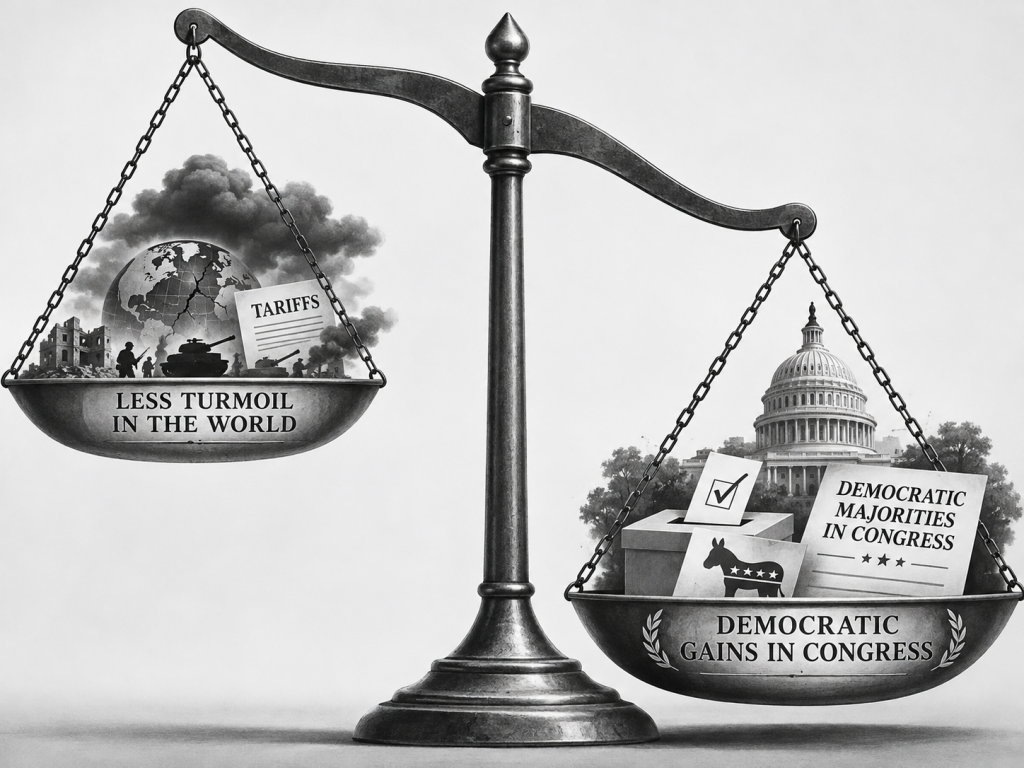
The US midterms have delivered Donald Trump more than just a political defeat. They have fundamentally changed the balance of power in Washington. Democrats now appear set to take control of both the House and the Senate. That matters because a president who has spent the past two years governing with remarkably little resistance from Congress will now finally face something that has largely been missing: effective checks and balances.
Let us assume, with near certainty, that Democrats do indeed secure both majorities. That does not mean Trump suddenly becomes powerless. Far from it. He remains President, Commander in Chief and retains substantial executive authority. But the political landscape around him changes significantly. Trump will be challenged earlier and more often than before.
We see that as a positive development. Coeus Capital consists of people, and people have opinions. Ours is that too much power in the hands of any president is unhealthy, particularly when that power is exercised unpredictably. More congressional oversight, more institutional resistance and more transparency are, in our view, good for the United States and good for the world.
So what could a double Democratic victory actually mean?
On domestic policy, major new legislation becomes much harder. Democrats can block large parts of the President’s agenda, chair committees, issue subpoenas and launch investigations. That includes scrutiny of government contracts, conflicts of interest and the financial activities of the Trump family.
Foreign policy is more complicated. Trump still has considerable room to act on Iran. But Congress controls the purse strings and can make further military escalation politically and financially more difficult. Hearings, budget restrictions and demands for explicit authorisation can all narrow the President’s room for manoeuvre. Ukraine and Russia present a similar picture. Trump can still negotiate, use executive authority and influence sanctions policy. But a Democratic Congress can push for renewed support for Ukraine, make sanctions harder to dismantle and frustrate attempts to move US policy closer to Moscow without meaningful congressional resistance.
Tariffs deserve special attention. A Democratic Congress cannot simply reverse every tariff imposed under Trump, nor can it automatically prevent him from using existing executive authorities to impose new ones. Presidential veto power still matters. But the era in which tariffs could be used almost casually as a political weapon becomes much harder, perhaps even impossible. Congress can investigate exemptions, challenge the legal basis of measures, block new legislative powers and raise the political cost of punishing individual countries at presidential discretion.
That alone would be a meaningful change.
There is also an uncomfortable personal dimension to all of this. The business interests of the Trump family, and the extraordinary overlap between political power and private financial gain, should have been subject to much greater scrutiny long before now. A Democratic majority will almost certainly change that.
For markets, the first reaction has been clear enough. At the time of writing, US equity futures are lower and the Dollar has weakened as investors digest the prospect of a full Democratic sweep. That forces us to acknowledge something slightly uncomfortable. Last week, we wrote that even major congressional surprises had historically produced surprisingly small market reactions. We still need to see how this initial response holds up, but apparently a political earthquake can move markets after all.
For Coeus, that lesson became very practical. One of our strategies started the week long the US Dollar and short Sterling. Yesterday afternoon, as election risk increased, we closed the position around 1.3413 and accepted what was still a manageable and acceptable loss. GBP/USD is now trading around 1.3462. For now, at least, it appears that we avoided a much more painful outcome. Closing a losing position never feels good. But carrying a vulnerable Dollar-long position through a binary political event would have felt considerably worse.
Good risk management is not always about being right.
It is about making sure you are still comfortable when you turn out to be wrong.